Shipping Container Offices and Conex Units for Rent & Sale in Dallas, TX
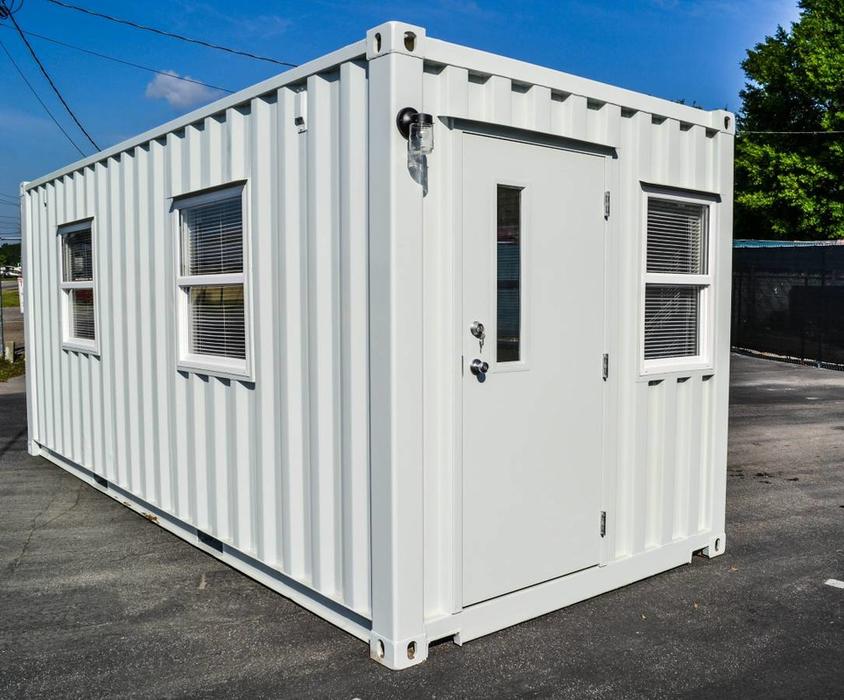
Need a ground level office you can walk straight into? Texas State Modular builds and delivers custom shipping container offices across Dallas, Fort Worth, and the rest of the Metroplex. Rent one for a six-month build. Buy one and keep it for twenty years.
We are locally owned and operated. Our yard sits in Alvarado, just south of the Metroplex, so freight stays cheap and set dates stay short. Every Conex office unit is built to fit the site it lands on.
What Is a Shipping Container Office?
A shipping container office is a steel cargo container converted into a working office. The unit arrives finished, insulated, wired, and ready to use. It sits flat on the ground, so no stairs or landing are needed.
Most of the trade calls this a Conex office unit. The name comes from the military. In late 1952 the U.S. Army Transportation Corps turned its “Transporter” prototype into the Container Express, or CONEX, system. Troops shortened it to Conex, and the term stuck. Those boxes later grew into the ISO shipping containers used worldwide today.
Modern units are built from Corten weathering steel. That is the same corrugated steel that survives ocean crossings, salt air, and stacking six high.
Conex, Connex, Ground Level Office: The Same Unit Under Different Names
Buyers search for this product under a dozen names. They all point to the same thing.
- Shipping container office or container office. The generic descriptions.
- Conex office or connex office. Conex is the correct spelling. Connex is a common misspelling, and we answer to both.
- Ground level office, or GLO. The industry term for a container office with no chassis and no steps.
- Storage container office. Usually a combo unit with an office on one end and locked storage on the other.
- Conex box office, sea can office, jobsite office, or portable office container. Regional and trade shorthand.
Ask five contractors in Dallas what to call it and you get five answers. Ask us for a ground level office or a Conex box. You get the same quote.
Shipping Container Office Sizes and Floor Plans
Container offices follow ISO 668 dimensions. That standard fixes the width at 8 feet and gives you three practical lengths.
| Size | External | Internal shell (approx.) | Floor area | Fits |
| 10 ft | 10′ x 8′ x 8’6″ | 9’4″ x 7’8″ x 7’10” | ~80 sq ft | 1 person, guard post, gate office |
| 20 ft | 20′ x 8′ x 8’6″ | 19’4″ x 7’8″ x 7’10” | ~160 sq ft | 2 to 4 people, or an office and storage combo |
| 40 ft | 40′ x 8′ x 8’6″ | 39’5″ x 7’8″ x 7’10” | ~320 sq ft | 5 to 8 people, or two private offices plus a common area |
A high cube container adds a foot of height. External height goes to 9’6″ and interior clearance to roughly 8’10”. That extra foot matters once you frame walls, drop insulation, and run ductwork.
One thing suppliers rarely mention: insulation and wall panels eat three to five inches off each interior dimension. A finished 20 foot office gives you closer to 18’10” of usable length, not 19’4″. Plan your desk layout off the finished number.
Common layouts we build:
- Open plan. One clear room with a man door and windows.
- Office and storage combo. A finished office on one end, a locked storage bay behind a partition wall.
- Office with half-bath. A working restroom in the corner, plumbed for a water line and a sewer connection or holding tank.
- Two-office split. A 40 foot unit divided into two private rooms.
Need something outside these footprints? See our custom modular builds.
20ft vs 40ft Container Office: Which Size to Buy
This is the decision most buyers get stuck on. Here is the honest breakdown.
| 20 ft container office | 40 ft container office | |
| Floor area | ~160 sq ft | ~320 sq ft |
| Workstations | 1 to 3 | 4 to 8 |
| Typical HVAC | 12,000 BTU single-zone | 18,000 BTU, or dual-zone with two heads |
| Site footprint needed | ~30′ x 12′ with swing room | ~55′ x 12′ with swing room |
| Delivery | Tilt-bed truck, tight sites work | Needs a longer approach and turning radius |
| Half-bath fits | Yes, but it eats a quarter of the room | Yes, with room left over |
| Buy price (market range) | $2,700 used to $17,400 fully finished | $8,700 to $23,700 depending on finish |
| Typical rental rate | Around $279 per month | Around $429 per month |
Pick the 20 foot if you have one to three people, a tight job site, or a lot with limited approach. It is the most common size sold for a reason. It fits where a trailer will not.
Pick the 40 foot if you need a meeting table, a private office plus a common area, or a combo unit with real storage behind a partition. Per square foot it is the cheaper buy. The catch is delivery access. Measure your gate and your turning radius before you order.
A note on two 20s versus one 40. Two 20 foot units cost more than one 40 and give you the same floor area. They win only when you need workspace in two separate locations, or when access rules out a 40 foot set.
How We Convert a Shipping Container Into an Office
We do the work in our Alvarado yard, not on your site. That means a controlled build and a shorter install day.
- Source and inspect the container. We start with a one-trip or cargo-worthy container. We check the floor, the corner castings, the door seals, and the roof for standing water damage. A bad shell costs more to fix than it saves.
- Cut the openings. Door and window openings get cut with a plasma torch, then reinforced with welded steel tube framing. Cutting a container weakens the wall, so every opening gets a header and jamb welded back in.
- Prime and seal. Cut edges get ground, primed, and sealed. Bare steel rusts fast in Texas humidity.
- Insulate. Closed-cell spray foam goes on the walls, ceiling, and underside. It bonds directly to the corrugation and blocks vapor at the same time.
- Frame and finish. We frame out the interior, run the rough electrical and any plumbing, then close up with wall panels and flooring.
- Install mechanical. HVAC, panel, lighting, and outlets go in. A licensed electrician does the terminations.
- Paint and deliver. Exterior paint in your colors, then a tilt-bed haul to your site and a set on your pad.
Standard builds ship faster than custom ones. Call for current lead times.
Insulation, HVAC, and Electrical Specs
Steel conducts heat. That single fact drives every spec decision in a container office.
Insulation
Closed-cell spray foam is the standard for a Texas build. It runs R-6 to R-7 per inch of thickness.
- 2 inches gives roughly R-12 to R-14. Fine for a job site office used during the day.
- 3 inches gives roughly R-18 to R-21. Better for year-round occupancy and lower running costs.
Spray foam bonds straight to the corrugated wall with no gaps. That matters because condensation forms wherever warm interior air touches cold steel, and condensation on a steel wall means rust behind your drywall.
Rigid foam board (XPS or polyiso) runs R-5 to R-6.5 per inch and costs less. It needs framing and a vapor barrier. We do not use open-cell foam on steel. It traps moisture against the wall.
Insulation is not an upsell you skip. A properly insulated shell cuts required cooling capacity by roughly 40 to 60 percent, so it pays for itself in a smaller HVAC unit and a lower power bill.
HVAC
A ductless mini-split heat pump is the usual choice. It heats and cools from one unit, runs quiet, and needs only a small wall penetration.
- 20 foot office: 12,000 BTU single-zone handles it.
- 40 foot office: 18,000 BTU, or a dual-zone system with two indoor heads for even distribution.
Sizing rule of thumb: 25 to 35 BTU per square foot for a well-insulated container. In North Texas, with sun on the long wall through August, plan closer to 40 to 50 BTU per square foot.
Do not oversize. An oversized unit short-cycles, never runs long enough to pull humidity out, and leaves the room cold and clammy.
Wall-mounted packaged units are the budget alternative. They cost less up front and more to run.
Electrical
A typical container office carries a 100 to 125 amp panel on 120/240V single phase. Standard build includes:
- A dedicated 240V circuit for the HVAC unit
- Two to three 20-amp general circuits for equipment and workstations
- A separate lighting circuit on LED fixtures
- GFCI protection on any exterior or wet-location receptacle
- Data and communications pass-throughs
For remote pads with no grid connection, we can add a 50 amp generator inlet so the unit runs off a portable generator.
All electrical work is installed and terminated by a licensed electrician as part of our turnkey service.
Ground Level Office vs Mobile Office Trailer: Which Fits Your Site
Both give you workspace on site. They are built differently and they suit different jobs.
A mobile office trailer sits on a steel chassis with axles and a hitch. It needs stairs or a ramp to get in. It delivers more square footage per dollar and moves between sites easily.
A Conex ground level office sits directly on the ground. Entry is a single step or none at all. The steel shell is harder to break into and the unit can be stacked.
Choose a container office when:
- Security is the priority. Steel walls and steel doors beat a trailer skin.
- Space is tight. A container fits where a trailer and its stairs will not.
- Access matters. Ground level entry is easier for daily foot traffic and deliveries.
- The unit stays put for a long stretch, or you plan to buy rather than rent.
Choose a mobile office trailer when you need more square footage, a faster install, or a unit that moves site to site every few months.
Need something bigger than either? Look at our modular buildings for offices and classrooms.
Container Office vs Office Trailer: The Cost Comparison
The sticker price is not the whole answer. Here is how the two compare on total cost.
| Container office | Mobile office trailer | |
| Monthly rent (DFW published ranges) | ~$279 for 20 ft, ~$429 for 40 ft | ~$250 for a compact, up to ~$1,800 for a large double wide |
| Buy price | ~$2,700 used, $7,000 to $17,400 new and finished | Varies widely by size and trim level |
| Cost per sq ft to rent | Higher. You pay for steel and security. | Lower. You pay for square footage. |
| Site prep | Gravel pad or level ground | Level pad, blocking, and tie-downs |
| Access | Ground level, no steps | Stairs or ramp required, often permitted separately |
| Relocation | Tilt-bed haul, straightforward | Tow behind a truck, faster |
| Security | Steel shell, steel doors | Standard trailer skin and door |
| Service life | 25+ years with upkeep | Shorter, and it depreciates faster |
Where the break-even sits. A finished 20 foot container office at $10,000 pays for itself against a $279 monthly rental in roughly 36 months. Past year three, ownership wins and keeps winning. Under two years, renting almost always costs less once you add delivery both ways.
The honest trade-off. If you need 400 square feet of desk space for a year, a trailer is cheaper. If you need 160 secure square feet on a site for five years, buy the container.
Costs that land on top either way: delivery and setting, site prep, utility hookups, permits, and any decks or ramps. Delivery quotes in the Dallas area often run around $1,400 per trip.
Those are market ranges, not our quote. Call 214-304-3416 and we will price your job.
What Does a Shipping Container Office Cost in Dallas?
Price depends on size, condition, finish level, and how much mechanical work goes in. Here is what suppliers publish for the Dallas market as of September 2026.
To buy:
- Used and refurbished 20 foot office containers list from roughly $2,700 to $6,500.
- New 20 foot ground level offices list from roughly $7,000 to $12,500.
- Fully finished 20 foot units with insulation, wall-mounted A/C, LED lighting, and a steel man door run $14,900 to $17,400.
- A 30 foot ground level office lists near $8,500 in DFW.
- Converted and insulated 40 foot container offices list from roughly $8,700 to $9,000.
To rent:
- National suppliers publish monthly rates near $279 for a 20 foot ground level office and $429 for a 40 foot unit.
What moves the number: insulation thickness, HVAC size, whether you add a half-bath, the number of windows and doors cut in, and container grade. A one-trip container costs more than a cargo-worthy used shell and looks it.
Rent, Lease, or Buy a Container Office in Texas
Three ways to get a unit. The right one depends on how long you need it.
Rent for Short Projects
Best for jobs under twelve months. You pay a monthly rate, we handle delivery and pickup, and the unit leaves when the job ends. No resale to worry about.
Lease for Multi-Year Work
Best for projects running one to five years. Monthly rates drop against a short-term rental, and you can still walk away at the end of the term.
Buy for Repeat Use
Best when the unit moves between your own sites for years. You own the asset, you control the modifications, and you stop paying rent. Used and refurbished units cut the entry cost.
We lease and sell from the same stock, so you can walk through a unit before you commit. Browse the current inventory fleet or call for what is on the lot this week.
Common Uses for Container Offices on Job Sites and Beyond
Container offices work anywhere you need secure workspace fast.
- Construction site offices. Plans, permits, and daily huddles on the job site. The steel shell doubles as tool security overnight.
- Real estate sales offices. Meet buyers on the lot in a new development before the model home is finished.
- Warehouse and manufacturing. Supervisor offices on the floor, without cutting into rack space.
- Energy and industrial sites. Climate-controlled workspace on remote pads and yards.
- Schools and campuses. Admin space, a nurse’s station, or coaching offices.
- Healthcare and testing. Intake rooms and screening space near an existing facility.
- Break rooms. A place for crews to sit down and eat. See how modular break rooms improve a workplace.
- Security checkpoints. Pair a small unit with our guard shacks and security booths.
- Home offices. A quiet, lockable workspace in the backyard.
For more layout ideas, read our guide to using shipping containers as offices.
Why Choose a Conex Office Unit?
Our container offices balance durability, function, and flexibility. Here is what you get.
- Secure and sturdy. Heavy-duty steel walls, steel doors, and lockable hardware protect your team, tools, and equipment.
- Weather-resistant. These units handle Texas heat, hail, and driving rain. The steel envelope keeps water out and conditioned air in.
- Long service life. With routine maintenance, a container office stays functional for 25 years or more.
- Ground level access. No stairs to build, no landing to permit, no ramp unless you want one.
- Customizable. Add a half-bath, extra windows, or a roll-up door and the unit fits your exact use.
Customize Your Container Office
We tailor every unit before it ships. Popular additions include:
- Wall-mounted HVAC or ductless mini-split systems for climate control
- Closed-cell spray foam or rigid board insulation with a finished interior
- 100 to 125 amp electrical panel, outlets, and LED lighting
- Plumbing for a half-bath or utility sink
- Windows with security bars
- Steel man doors, walk-through doors, or roll-up doors
- Data and communications pass-throughs
- Interior partition walls for private offices
- Decks and ramps for ADA-compliant access
- Exterior paint in your company colors
Adding a restroom to the site instead of the unit? We also supply Conex restroom units and modular restroom units.
Site Prep, Delivery, and Permits for Container Offices in Texas
Do You Need a Concrete Slab?
No. A container office does not need a poured foundation. It needs a firm, level, compacted surface so the doors swing true and any plumbing drains correctly. A gravel pad works. So does a concrete slab, and so does compacted soil on a flat lot.
All four corner castings must sit supported. The delivery truck also needs room to maneuver and set the unit.
What About Permits?
The rules in Texas depend on how the unit is used. The Texas Department of Licensing and Regulation runs the Industrialized Housing and Buildings program under Chapter 1202 of the Occupations Code. Section 1202.003 leaves construction site buildings out of that program. It also leaves out units on temporary foundations that are closed to the public and under 1,500 square feet.
A job trailer and a permanent office follow different paths. Local jurisdictions add their own requirements on top.
We Handle It
Most container suppliers drop a box and drive off. We run the job as a general contractor. Our turnkey modular building services cover:
- Layout planning and design
- Permit acquisition
- Site preparation
- Electrical, HVAC, and plumbing installation
- Utility connections
- Data and communications
- ADA-compliant decks, ramps, and steps
- Canopies and exterior additions
A dedicated project manager stays on your timeline and budget.
Container Offices Across Dallas-Fort Worth
Our yard is at 9120 Sally’s Way in Alvarado, TX. From there we cover the full Metroplex.
We deliver container offices to Dallas, Fort Worth, Arlington, Plano, Irving, Garland, Frisco, McKinney, Denton, Mansfield, Cleburne, Waxahachie, and the surrounding counties. A shorter haul means lower freight and a faster set date.
Project managers also cover Oklahoma, Arkansas, and Louisiana for multi-state work.
See our full range of Dallas shipping containers, or read about business uses for mobile offices in Fort Worth.
Why Choose Texas State Modular?
- You reach a local person. Call us and you talk to someone in the Metroplex, not a national call center.
- Locally owned and operated. We know how Texas sites, inspectors, and weather actually behave.
- Full-service general contractor. We handle permitting, site work, utilities, and installation, not just the drop-off.
- In-stock fleet. More than 30 units on the lot, plus custom container builds.
- Conversions done in house. We cut, weld, frame, and finish in our own yard, so we control the quality.
Office hours are 7:30 am to 6:00 pm, Monday through Friday. Browse finished projects in our gallery to see the work.
FAQs About Shipping Container Offices
What is a Conex office unit?
A Conex office unit is a heavy-duty steel shipping container professionally converted into a fully functional, ground-level office. They are secure, weather-resistant, and work well for construction sites, real estate sales offices, home offices, and growing businesses that need extra space fast.
Is it spelled Conex or Connex?
Conex is correct. It is short for Container Express, the U.S. Army logistics system introduced in late 1952. Connex is a common misspelling that shows up constantly in search. Both refer to the same steel container.
What is a ground level office?
A ground level office, or GLO, is a container office that sits directly on the ground with no chassis and no wheels. That is the same product as a Conex office unit. Office trailers are not ground level because they sit on a frame with axles.
How much does a shipping container office cost?
Buying prices in the Dallas market run from about $2,700 for a used 20 foot unit to roughly $17,400 for a fully finished one. Monthly rentals start near $279 for a 20 foot unit. Delivery, site prep, and utility hookups are separate. Call 214-304-3416 for a quote on your job.
Should I get a 20ft or 40ft container office?
Get the 20 foot for one to three people or a tight site. Get the 40 foot for four or more people, a meeting area, or a combo unit with storage. The 40 foot costs less per square foot but needs more room to deliver and set.
What sizes do container offices come in?
Standard lengths are 10, 20, and 40 feet, all 8 feet wide. Standard height is 8’6″. A high cube adds a foot, bringing external height to 9’6″. A 20 foot unit gives about 160 square feet and a 40 foot unit about 320.
How do you insulate a shipping container office?
Closed-cell spray foam applied straight to the steel is the standard method. Two inches gives about R-12 to R-14 and three inches about R-18 to R-21. It also blocks vapor, which stops condensation and rust behind the wall panels. Rigid foam board is a lower-cost alternative and needs framing.
What size air conditioner does a container office need?
A 20 foot office typically runs a 12,000 BTU mini-split. A 40 foot office needs 18,000 BTU or a dual-zone system. In North Texas heat, size at 40 to 50 BTU per square foot rather than the usual 25 to 35.
What electrical does a container office come with?
A typical build carries a 100 to 125 amp panel on 120/240V single phase, a dedicated HVAC circuit, two to three 20-amp general circuits, a separate LED lighting circuit, and GFCI protection outside. We can add a 50 amp generator inlet for off-grid sites.
How long does a container office conversion take?
Standard builds ship faster than custom ones. The build itself runs through sourcing, cutting and reinforcing openings, insulation, framing and finish, mechanical install, and paint. Call for current lead times on the layout you want.
How long do container offices last?
With routine maintenance, a container office stays functional for over 25 years. The Corten steel construction resists weather, wear, and tampering, making it a reliable long-term investment.
Do container offices need a foundation?
No. Container offices sit at ground level and only require a firm, level surface, which means faster setup and easier entry than raised office trailers. A gravel pad or concrete slab both work. Decks and ramps can be added if your site needs them.
Can a container office include a restroom?
Yes. We can build dual-function offices with integrated half-baths, along with plumbing, electrical outlets, and HVAC systems, so your team has everything they need in one unit.
Are container offices secure enough to leave on a job site overnight?
Yes. These units are constructed from heavy-duty steel with steel doors and lockable hardware, which makes them a safe place for your team, tools, and equipment even on unattended sites.
Is a container office cheaper than an office trailer?
It depends on the term. A finished 20 foot container at $10,000 breaks even against a $279 monthly rental around month 36. Under two years, renting a trailer usually costs less. Over three years, owning a container wins.
Do I need a permit for a container office in Dallas?
It depends on the use. Construction site buildings sit outside the TDLR industrialized buildings program, and so do units under 1,500 square feet on temporary foundations that are closed to the public. Local jurisdictions still have their own rules. We handle permit acquisition as part of our turnkey service.
Get a Container Office Quote Today
Call us for a free, no-obligation quote, or send us your project details. Tell us the size, the site, and the timeline. We will tell you what it costs and when it lands.
Need more than a container office? We also supply mobile office trailers, modular buildings, and restroom units across Dallas-Fort Worth.